

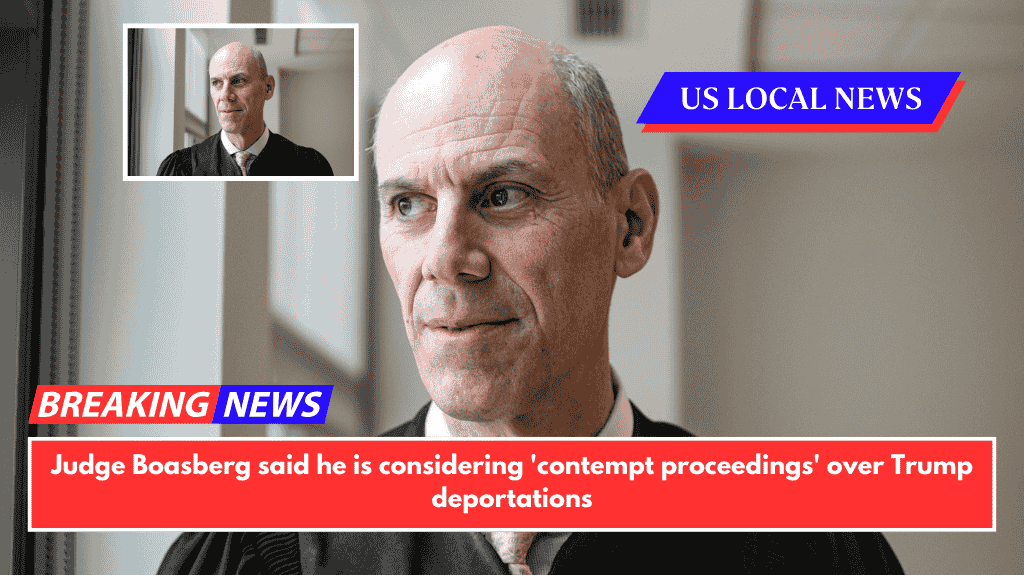
Nearly three weeks after President Donald Trump used the Alien Enemies Act to deport over 200 alleged migrant gang members to El Salvador with little to no due process, a federal judge will decide whether the Trump administration violated his court order by deporting the men.
At a hearing Thursday, U.S. District Judge James Boasberg said he is considering “contempt proceedings” against the government if he finds probable cause that they deliberately defied his March 15 order, which barred removals under the Alien Enemies Act and ordered the return of two flights carrying alleged Venezuelan gang members to the United States.

Boasberg questioned DOJ attorney Drew Ensign about the best way to proceed in the case if he determines that the government violated his verbal order to return the flights to the United States.
“If I don’t agree, I don’t find your legal arguments convincing, and I believe there is probable cause to find contempt, what I’m asking is how — how should I determine who [is at fault]?” Boasberg asked.
Boasberg repeatedly pressed Ensign for more information on who might have been involved in potentially violating his order. Ensign cited various privileges that could apply to the specific information, but when pressed by Boasberg, he stated that he was not prepared to provide specific answers.

Judge Boasberg stated that he intends to issue a decision sometime next week.
The judge began the hearing by criticizing Ensign after the DOJ lawyer insisted that the Trump administration followed Boasberg’s court order.
“It seems to me, there is a fair likelihood that that is not correct,” Judge Boasberg said in response to the argument that the Trump administration followed the order. “The government acted in bad faith throughout the day. You truly believed that everything you did that day was legal and could withstand a court challenge. I can’t believe you would have acted the way you did.

When the judge pressed the government on whether his oral directive to turn around the planes was communicated to the officials in charge of the deportation flights, DOJ attorney Drew Ensign declined to respond, citing attorney-client privilege. Regardless, Judge Boasberg suggested that the Trump administration acted irresponsibly by rushing deportation flights while the lawsuit was pending.
“Why wouldn’t it be prudent to say, ‘Let’s slow down here’? Let us see what the judge says. He has already ordered the removal of five people, and it is certainly possible that he will order additional removals. Let’s hear what he says, and if he doesn’t like it, we can go ahead. But surely it’s better to be safe than risk violating the order,” Judge Boasberg said.
Boasberg used his opening line of questioning to ensure Ensign corrected the record in the face of public attacks from President Trump and other senior administration officials accusing him of supporting terrorist gang members or single-handedly obstructing the administration’s immigration agenda.
Ensign stated that Boasberg’s initial temporary restraining order issued on March 15 never prohibited the administration from conducting deportations in the normal course of legal proceedings, and that Boasberg never ordered the release of any TdA members in the administration’s custody.
Thursday’s hearing could be the most significant clash between the executive and judicial branches of government since Trump took office in January, as he attempts to implement parts of his agenda unilaterally amidst a flood of litigation.
“I’m just doing what the voters wanted me to do,” Trump said in a social media post last month, following Judge Boasberg’s order to halt the deportations.
Last month, Trump invoked the Alien Enemies Act, a wartime authority used to deport noncitizens with little to no due process, claiming that the Venezuelan gang Tren de Aragua is a “hybrid criminal state” invading the United States.
An official with the U.S. Immigration and Customs Enforcement acknowledged that “many” of the men do not have criminal records in the United States, but added that “the lack of specific information about each individual actually highlights the risk they pose” and “demonstrates that they are terrorists with regard to whom we lack a complete profile.”
Lawyers for the migrants covered by the president’s Alien Enemies Act proclamation claim that the Trump administration violated the court’s “unequivocal oral order” to return two flights carrying alleged Tren de Aragua gang members to El Salvador.
According to flight data reviewed by ABC News, both flights carrying the migrants had not yet landed when Judge Boasberg directed that they be turned around. When questioned by Judge Boasberg, Justice Department lawyers confirmed that the directive was promptly communicated to federal officials overseeing the flights.
“Defendants admit they never attempted to return the individuals on the planes to the United States, despite having both notice and the ability to do so,” their attorneys said.
Lawyers for the Department of Justice have insisted that the Trump administration “complied with the law” while questioning Judge Boasberg’s order. According to the DOJ, Judge Boasberg’s oral instructions ordering the flight’s return were defective, and his subsequent written order lacked the necessary explanation to be enforced.
Lawyers from the ACLU and Democracy Forward Foundation responded, “The government’s arguments are also unsupportable on their own terms — as a matter of basic textual analysis, common sense, and in view of foundational separation-of-powers principles.”
The Justice Department has also argued that the president acted within his authority when he removed the noncitizens, whom the Trump administration claims are dangerous gang members, and that the government should not have to explain itself to the court because the issue is national security.
“Even without the challenged Proclamation, the President doubtlessly acts within his constitutional prerogative by declining to transport foreign terrorists into the country,” the attorney general’s office claimed.
The Justice Department recently invoked the rarely used state secrets privilege to avoid disclosing additional information about the flights on the grounds that it could jeopardize national security, so it’s unclear how DOJ lawyers will respond to Boasberg’s questions.